Background
The client is a non-profit civil society organization that primarily provides elderly care services through social work, nursing care, and volunteer services.
Challenges
The client’s first project was launched in 2021, aiming to serve 300 households of elderly people in difficult situations, with a planned execution cycle of one year. However, it actually took a year and a half to complete, with two months spent solely on organizing project archives. At that time, the project management approach was very traditional, with all collected materials being paper-based files. This led to delays, low accuracy, frequent omissions, and errors in filling out forms. Discovering mistakes required repeated verification, resulting in poor efficiency.
As a public welfare project, the client sought a solution that could address three major pain points:
- Enhancing Transparency: The operations of public welfare organizations particularly emphasize openness and transparency, which are crucial for maintaining the trust of funders and the public. To ensure their charitable actions are recognized, it is essential to provide clear and transparent channels for information disclosure.
- Improving Project Management Efficiency
- Limited Budget: Public welfare projects cannot allocate large or multiple budgets for informatization construction. It is necessary to fully consider the implementation timeline and the costs of future demand iterations and optimizations.
Value
- The system constructed under this proposal has digitized the entire process from service recipient screening and information collection to renovation process recording and material sign-off. All stages are visible in real-time, ensuring the project’s transparency.
- Efficient Implementation with Controllable Costs: The entire project management system was implemented in just two weeks, costing only 40% of traditional development models, and can flexibly adapt to future demand changes. Since its launch, the system has served nearly 1,000 households of elderly people in difficult situations, improving efficiency by more than four times.
- Comprehensive Data Management and Process Optimization: The system built under this proposal is a complete process management system for aging-friendly renovations. From the initial collection of service recipient information to the final audit mechanism, each step is equipped with specialized functions. This digital transformation not only allows for further expansion of the project scope but also provides a solid foundation for future elderly social work services and other public welfare projects, paving the way for innovation in public welfare in the digital era.
Core Application Scenarios
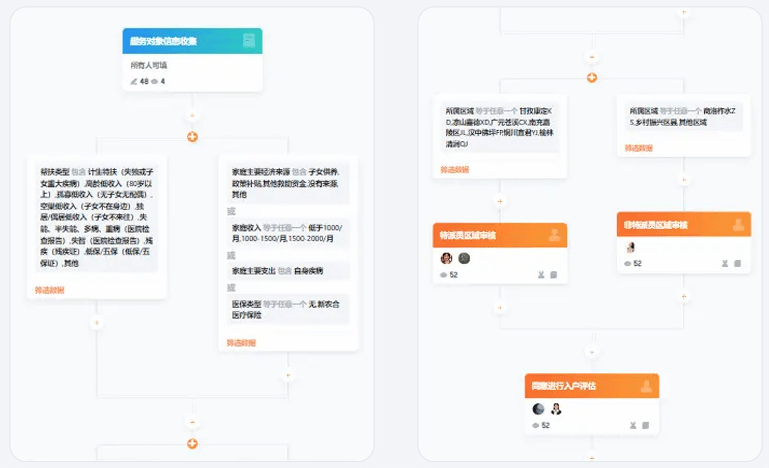
Initial Project Phase: Service Recipient Screening
To ensure that elderly people truly in need can benefit from public welfare, the project requires screening and evaluation of service recipients based on age, economic status, health condition, and other factors.
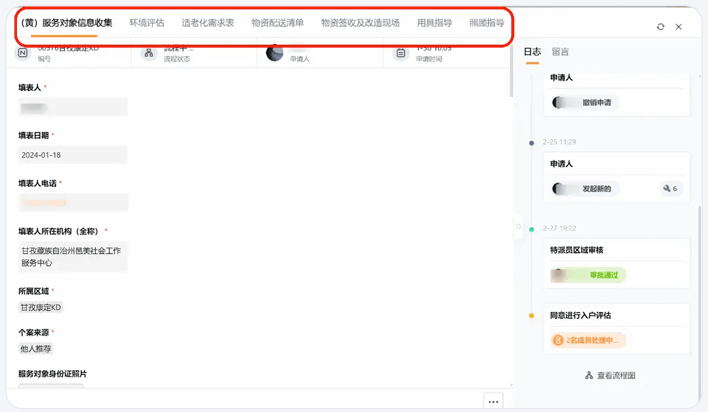
Each service recipient’s information needs to be registered in the system, including identity proof, income proof, and related graphic information, ensuring the information is authentic and reliable.

After entering the service recipient’s information, it is automatically routed to the corresponding regional reviewer’s to-do list based on regional information for approval. Once approved, it automatically proceeds to the next stage.
Mid-Project Phase: Multi-Dimensional Evaluation, Real-Time Feedback, Automatic Calculation of Material Costs
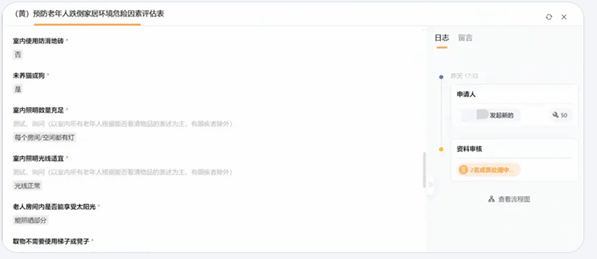
After determining the service recipients, the next step is to conduct a comprehensive evaluation based on the actual living environment and specific needs of the recipients to determine the renovation plan.
Compared to the past, where paper-based evaluation reports were time-consuming to collect, submit, and organize, the project team now directly fills in evaluation information in the system, including on-site evaluation videos, images, and documents submitted online. After submission, the information automatically flows according to the set process, providing real-time feedback and advancing the project.

Once the evaluation is completed, suppliers provide renovation plans based on the evaluation information. Each household has a budget limit, and if exceeded, an additional online application is required.
In the past, the amount for each household was calculated manually, which was prone to errors. The system’s automated calculation avoids such risks, ensuring strict financial control.
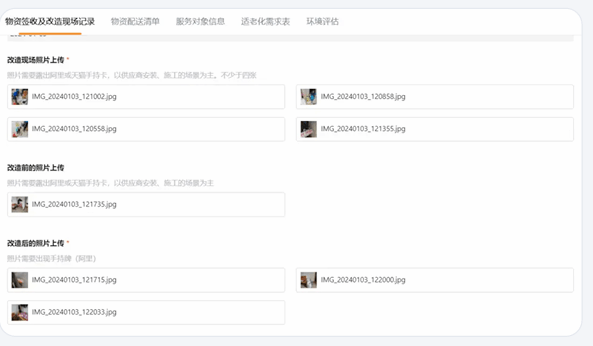
After the materials are delivered, the renovation implementation phase begins. Similarly, this phase is also recorded and submitted through the system.
During the renovation, social workers directly use their phones to take photos and videos, documenting the renovation process. Supervisors can log in to the system to clearly see the renovation status of each household and the overall progress.
Post-Project Phase: Information Archiving and Quick Export
After the renovation is completed, the client needs to compile detailed renovation information for each household and collect various reports, including summary reports, case photos, executing agency feedback, service recipient feedback, and satisfaction surveys. This is the most time-consuming part.
In the past, this phase took at least 1-2 months to complete. Now, using the service recipient’s identity information as an identifier, information can be quickly associated, archived, and printed as a complete file.
 DIGITURBO